

Cardiovascular Health
Kaneka Ubiquinol® Promotes Healthy Circulatory Function
Ubiquinol is the active antioxidant form of coenzyme Q10 (CoQ10), an essential part of the body’s cellular energy generation process. It plays a critical role in healthy cellular function and physiological processes linked to cardiovascular health.
Supplementation with Kaneka Ubiquinol®, bioidentical to the body’s natural ubiquinol, has been shown to support endothelial function and vasodilation,1 protect LDL from oxidation,1,2 replenish statin-depleted CoQ10 levels,3 and improve blood markers associated with cardiovascular wellness.4
Kaneka Ubiquinol® Supports Endothelial Function, Promotes Healthy Vasodilation, and Protects LDL Cholesterol from Oxidative Modification1
In an 8-week, randomized, double-blind, placebo-controlled, single-center trial, with the primary outcome of change in flow-mediated dilation (FMD) in healthy patients with mild-to-moderate dyslipidemia, Kaneka Ubiquinol® significantly improved circulatory function (P=0.001).1
Improvement in FMD1,a,b
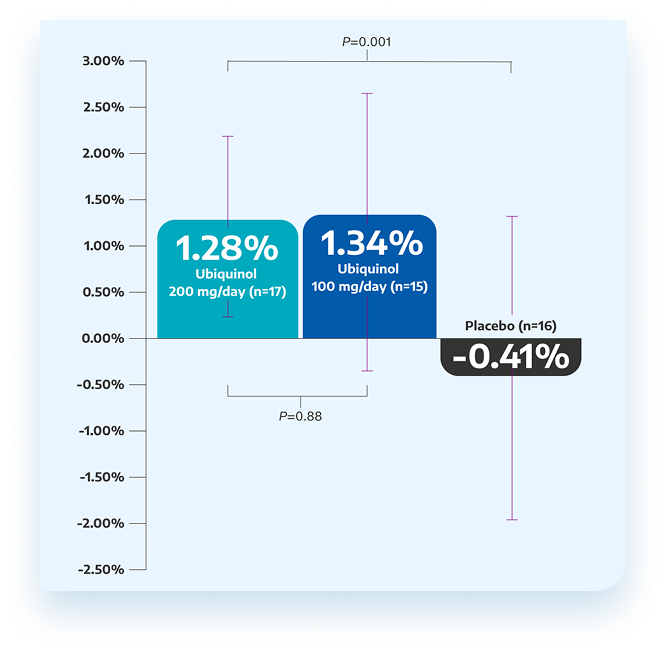
The observed improvement in FMD correlated with:
- Serum levels of nitric oxide metabolites, indicating that supplementation with Kaneka Ubiquinol® had a positive impact on nitric oxide bioavailability.1
- LDL oxidation lag time, indicating Kaneka Ubiquinol® 200 mg/day supports LDL antioxidant defense.1
aResponse with ubiquinol was dose-independent.
bNo significant changes in plasma lipid profile between groups or versus baseline for either group (one-way ANOVA, P=0.905). Ubiquinol improved endothelium-dependent vasodilation independent of plasma cholesterol levels.
Kaneka Ubiquinol® Replenishes CoQ10 Levels Depleted by Statin Medications3
Cholesterol-lowering statins can significantly lower the amount of total CoQ10 (ubiquinol + ubiquinone) in the blood,5-7 even when a patient has taken a standard dose for only 3 months.5 This depletion can lead to muscle discomfort.3
Daily supplementation with Kaneka Ubiquinol® can replenish CoQ10 levels,3,8 which supports cardiac function and muscle health during statin use.3,9
Find coding resourcesKaneka Ubiquinol® significantly decreased GGT activity from baseline to day 14 in healthy male volunteers4
2.7 U/L mean decrease in GGT activity over 14 days4,c
cP < 0.001. GGT activity decreased from 20.49 ± 10.36 U/L to 17.79 ± 7.68 U/L (mean ± standard deviation). Male population (n=53) aged 21 to 48 supplemented with 150 mg Kaneka Ubiquinol® once daily for 2 weeks.
Kaneka Ubiquinol® Improved a Blood Marker Associated With Cardiovascular Wellness4
Gamma glutamyltransferase (GGT) is considered a marker of oxidative stress.4 Maintaining GGT levels within normal ranges is associated with cardiovascular health.4,10,11
Supplementation with Kaneka Ubiquinol® has been shown to reduce GGT levels in men.4
Higher ubiquinol levels are associated with lower levels of blood markers NT-proBNP and CRP
NT-proBNP
Higher serum levels of ubiquinol are associated (P<0.05) with lower serum levels of N-terminal pro b-type natriuretic peptide (NT-proBNP), a marker associated with certain cardiovascular conditions.12
CRP
In a study in 1,319 participants, ubiquinol status in plasma was significantly (P<0.001) correlated to the concentration of c-reactive protein (CRP), a nonspecific marker of inflammation.13
Cardiovascular health is closely tied to other key wellness factors, including mitochondrial function and healthy aging.
See more uses for Kaneka Ubiquinol®
REFERENCES: 1. Sabbatinelli J, Orlando P, Galeazzi R, et al. Ubiquinol ameliorates endothelial dysfunction in subjects with mild-to-moderate dyslipidemia: a randomized clinical trial. Nutrients. 2020;12(4):1098. 2. Stocker R, Bowry VW, Frei B. Ubiquinol-10 protects human low density lipoprotein more efficiently against lipid peroxidation than does alpha-tocopherol. Proc Natl Acad Sci U S A. 1991;88(5):1646-1650. 3. Zlatohlavek L, Vrablik M, Grauova B, Motykova E, Ceska R. The effect of coenzyme Q10 in statin myopathy. Neuro Endocrinol Lett. 2012;33(suppl 2):98-101. 4. Onur S, Niklowitz P, Jacobs G, et al. Ubiquinol reduces gamma glutamyltransferase as a marker of oxidative stress in humans. BMC Res Notes. 2014;7:427. 5. Passi S, Stancato A, Aleo E, Dmitrieva A, Littarru GP. Statins lower plasma and lymphocyte ubiquinol/ubiquinone without affecting other antioxidants and PUFA. Biofactors. 2003;18(1-4):113-124. 6. De Pinieux G, Chariot P, Ammi-Saïd M, et al. Lipid-lowering drugs and mitochondrial function: effects of HMG-CoA reductase inhibitors on serum ubiquinone and blood lactate/pyruvate ratio. Br J Clin Pharmacol. 1996;42(3):333-337. 7. Mortensen SA, Leth A, Agner E, Rohde M. Dose-related decrease of serum coenzyme Q10 during treatment with HMG-CoA reductase inhibitors. Mol Aspects Med. 1997;18(suppl):S137-S144. 8. Fedacko J, Pella D, Fedackova P, et al. Coenzyme Q10 and selenium in statin-associated myopathy treatment. Can J Physiol Pharmacol. 2013;91(2):165-170. 9. Kawashima C, Matsuzawa Y, Konishi M, et al. Ubiquinol improves endothelial function in patients with heart failure with reduced ejection fraction: a single-center, randomized double-blind placebo-controlled crossover pilot study. Am J Cardiovasc Drugs. 2020;20(4):363-372. 10. Lee DH, Jacobs DR Jr, Gross M, et al. Gamma-glutamyltransferase is a predictor of incident diabetes and hypertension: the Coronary Artery Risk Development in Young Adults (CARDIA) Study. Clin Chem. 2003;49(8):1358-1366. 11. Dhingra R, Gona P, Wang TJ, Fox CS, D'Agostino RB Sr, Vasan RS. Serum gamma-glutamyl transferase and risk of heart failure in the community. Arterioscler Thromb Vasc Biol. 2010;30(9):1855-1860. 12. Onur S, et al. Association between serum level of ubiquinol and NT-proBNP, a marker for chronic heart failure, in healthy elderly subjects. Biofactors. 2015;41(1):35-43. 13. Fischer A, Onur S, Niklowitz P, Menke T, Laudes M, Döring F. Coenzyme Q10 redox state predicts the concentration of c-reactive protein in a large caucasian cohort. Biofactors. 2016;42(3):268-276.