
About Ubiquinol
Get to Know the Ubiquitous Coenzyme
Coenzyme Q10 (CoQ10) is a fat-soluble molecule naturally present in every cell of the body. It is an essential part of the mitochondrial respiratory chain.
CoQ10 is naturally synthesized by the body and consumed as part of a regular diet. Dietary sources, however, generally provide less than 3 mg/serving, which is insufficient to effectively replenish depleted CoQ10 levels.1,2
Overall CoQ10 levels in the body may be reduced by a number of causes, including aging,3 certain health conditions,4 and use of statin medications.5
CoQ10 Has 2 Forms: Ubiquinone and Ubiquinol
- Ubiquinone is the oxidized form of CoQ10
- Ubiquinol is the reduced form of CoQ10
- Has 2 additional electrons
- Active antioxidant form6,7
CoQ10 cycles between its oxidized state, ubiquinone, and its reduced form, ubiquinol, as it performs its role in energy generation and, as ubiquinol, supplying antioxidant activity.8
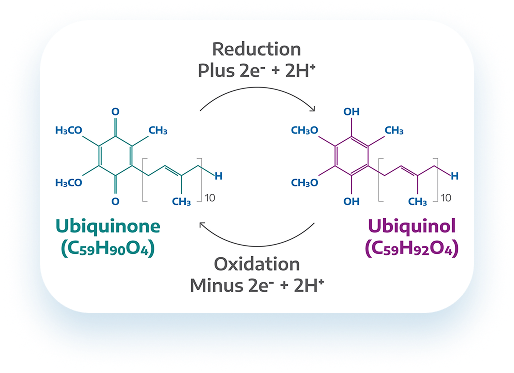
Whether synthesized naturally or taken as a CoQ10 supplement, ubiquinone must be converted by the body into ubiquinol for it to be transported in the blood and act as an antioxidant.9,10
Ubiquinol Plays a Crucial Role in Cellular Health
Ubiquinol is the active antioxidant form of CoQ10.6,7 It shields cells against oxidative stress, which may affect lipids, proteins, and DNA.11,12
In healthy adults, approximately 95% of CoQ10 circulating in the blood is in the form of ubiquinol.13,14
Ubiquinol drives production of adenosine triphosphate (ATP), the energy currency of the cell.15
Vitamin E, another essential lipid-soluble antioxidant, is only obtainable from dietary sources. Ubiquinol is unique in that it is the only lipid-soluble antioxidant synthesized by the body and is capable of regenerating vitamin E.7
Give Your Patients the Kaneka Ubiquinol® Advantage
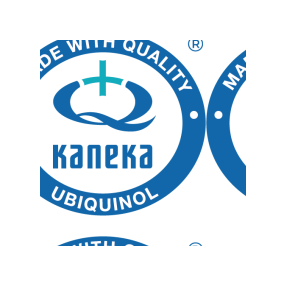
Tell your patients to look for the Kaneka Quality Seal
Help patients identify Kaneka Ubiquinol® by looking for the Kaneka Quality Seal, featured on more than 200 trusted supplement brands. This mark ensures your patients are getting the most studied and trusted form of ubiquinol available.
Give Your Patients the Kaneka Ubiquinol® Advantage
Tell your patients to look for the Kaneka Quality Seal
Help patients identify Kaneka Ubiquinol® by looking for the Kaneka Quality Seal, featured on more than 200 trusted supplement brands. This mark ensures your patients are getting the most studied and trusted form of ubiquinol available.
Developed by the industry leader in CoQ10 research and manufacturing, Kaneka Ubiquinol® offers healthcare providers a science-backed choice for ubiquinol supplementation.
Discover the Kaneka Ubiquinol® advantage
REFERENCES: 1. Weber C, Bysted A, Hłlmer G. The coenzyme Q10 content of the average Danish diet. Int J Vitam Nutr Res. 1997;67(2):123-129. 2. Bhagavan HN, Chopra RK. Plasma coenzyme Q10 response to oral ingestion of coenzyme Q10 formulations. Mitochondrion. 2007;7(suppl):S78-S88. 3. Niklowitz P, Onur S, Fischer A, et al. Coenzyme Q10 serum concentration and redox status in European adults: influence of age, sex, and lipoprotein concentration. J Clin Biochem Nutr. 2016;58(3):240-245. 4. Zozina VI, Covantev S, Goroshko OA, Krasnykh LM, Kukes VG. Coenzyme Q10 in cardiovascular and metabolic diseases: current state of the problem. Curr Cardiol Rev. 2018;14(3):164-174. 5. Passi S, Stancato A, Aleo E, Dmitrieva A, Littarru GP. Statins lower plasma and lymphocyte ubiquinol/ubiquinone without affecting other antioxidants and PUFA. Biofactors. 2003;18(1-4):113-124. 6. Littarru GP, Tiano L. Bioenergetic and antioxidant properties of coenzyme Q10: recent developments. Mol Biotechnol. 2007;37(1):31-37. 7. Ernster L, Forsmark-Andrée P. Ubiquinol: an endogenous antioxidant in aerobic organisms. Clin Investig. 1993;71(8 Suppl):S60-S65. 8. Navas P, Villalba JM, de Cabo R. The importance of plasma membrane coenzyme Q in aging and stress responses. Mitochondrion. 2007;7(suppl):S34-S40. 9. Takahashi T, Mine Y, Okamoto T. Extracellular coenzyme Q10 (CoQ10) is reduced to ubiquinol-10 by intact Hep G2 cells independent of intracellular CoQ10 reduction. Arch Biochem Biophys. 2019;672:108067. 10. Mohr D, Bowry VW, Stocker R. Dietary supplementation with coenzyme Q10 results in increased levels of ubiquinol-10 within circulating lipoproteins and increased resistance of human low-density lipoprotein to the initiation of lipid peroxidation. Biochim Biophys Acta. 1992;1126(3):247-254. 11. Bentinger M, Brismar K, Dallner G. The antioxidant role of coenzyme Q. Mitochondrion. 2007;(suppl 7):S41-50. 12. Sies H. Strategies of antioxidant defense. Eur J Biochem. 1993;215(2):213-219. 13. Tang PH, Miles MV, DeGrauw A, Hershey A, Pesce A. HPLC analysis of reduced and oxidized coenzyme Q(10) in human plasma. Clin Chem. 2001;47(2):256-265. 14. Yamashita S, Yamamoto Y. Simultaneous detection of ubiquinol and ubiquinone in human plasma as a marker of oxidative stress. Anal Biochem. 1997;250(1):66-73. 15. Martini FH, Nath JL, Bartholomew EF. Metabolism, nutrition, and energetics. In: Fundamentals of Anatomy and Physiology, 12th ed. Pearson Education; 2024:943-950.