
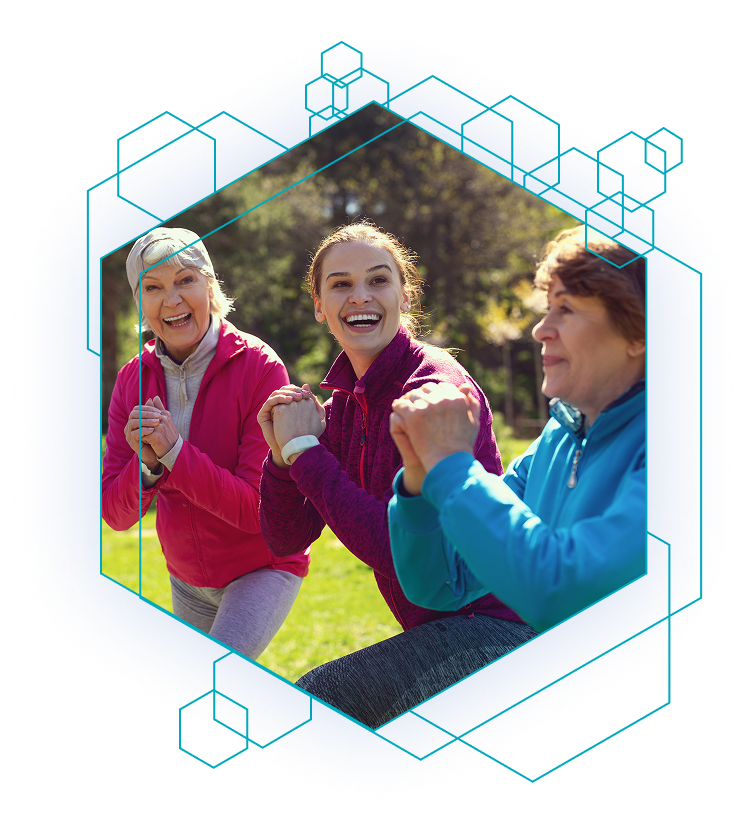
Healthy Aging
Kaneka Ubiquinol® Supports Processes Central to Wellness in Your Patients’ Later Years
Ubiquinol, the active antioxidant form of coenzyme Q10 (CoQ10), is essential for healthy cellular function and energy production.1-3 It serves in part to neutralize reactive oxygen species (ROS), a byproduct of cellular energy generation. In excess, ROS can overwhelm the natural supply of ubiquinol and other antioxidants, leading to oxidative stress.2,4
Oxidative stress may also be exacerbated by lifestyle factors, such as diet and smoking.5 Over time, oxidative stress negatively affects cellular and mitochondrial DNA, energy production, lipids, and proteins.5
Aging Impacts Naturally Occurring Ubiquinol Levels
Ubiquinol and the oxidized form of CoQ10, ubiquinone, are a “redox pair,” cycling between these 2 states as they perform their roles in cellular energy generation and, as ubiquinol, supplying antioxidant activity.6 In healthy adults, approximately 95% of CoQ10 circulating in the blood is in the form of ubiquinol.7,8
Ubiquinol levels have been shown to decline with age, however, in part because the ability to convert ubiquinone to ubiquinol becomes less efficient.9,10
Increasing Levels With Kaneka Ubiquinol® Supplementation
Clinical research has shown that supplementation with Kaneka Ubiquinol® raises plasma ubiquinol levels.11,12
Maintaining adequate serum ubiquinol levels may support muscle health and physical functioning in older adults.13,14
Kaneka Ubiquinol® also supports:
- Physiological processes linked to cardiovascular health, including endothelial function and healthy vasodilation12
- Replenishing CoQ10 levels depleted by statin medications15
- General health and well-being during and after menopause16,17
Download a Convenient, Science-Based Guide
Download a Convenient, Science-Based Guide
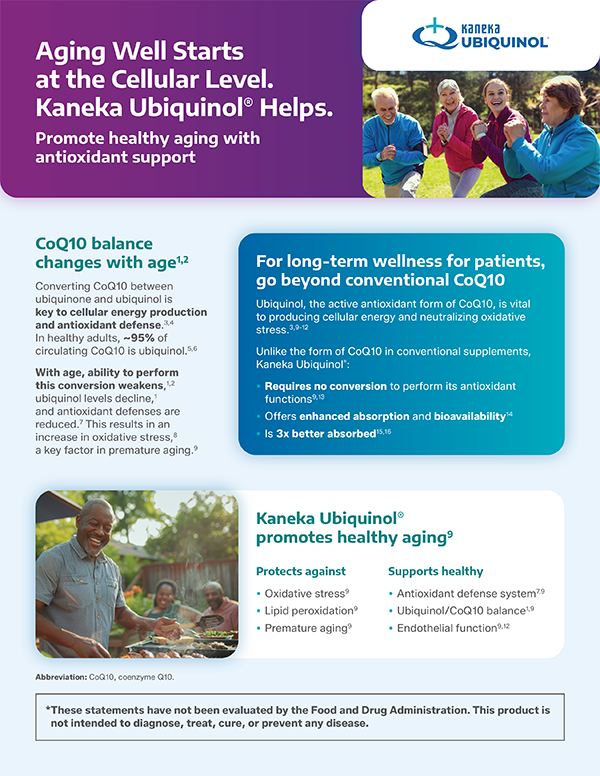
With a focus on long-term wellness, this information sheet provides a brief overview of the science of ubiquinol, research findings, the Kaneka Ubiquinol® advantage, and identifying supplements with the Kaneka Quality Seal.
DownloadHealthy aging is closely tied to other key wellness factors, including cardiovascular health, menopause, and mitochondrial function.
See more uses for Kaneka Ubiquinol®
REFERENCES: 1. Littarru GP, Tiano L. Bioenergetic and antioxidant properties of coenzyme Q10: recent developments. Mol Biotechnol. 2007;37(1):31-37. 2. Ernster L, Forsmark-Andrée P. Ubiquinol: an endogenous antioxidant in aerobic organisms. Clin Investig. 1993;71(8 Suppl):S60-S65. 3. Martini FH, Nath JL, Bartholomew EF. Metabolism, nutrition, and energetics. In: Fundamentals of Anatomy and Physiology, 12th ed. Pearson Education; 2024:943-950. 4. Bentinger M, Brismar K, Dallner G. The antioxidant role of coenzyme Q. Mitochondrion. 2007;7(suppl):S41-S50. 5. Lobo V, Patil A, Phatak A, Chandra N. Free radicals, antioxidants and functional foods: Impact on human health. Pharmacogn Rev. 2010;4(8):118-126. 6. Navas P, Villalba JM, de Cabo R. The importance of plasma membrane coenzyme Q in aging and stress responses. Mitochondrion. 2007;7(suppl):S34-S40. 7. Tang PH, Miles MV, DeGrauw A, Hershey A, Pesce A. HPLC analysis of reduced and oxidized coenzyme Q(10) in human plasma. Clin Chem. 2001;47(2):256-265. 8. Yamashita S, Yamamoto Y. Simultaneous detection of ubiquinol and ubiquinone in human plasma as a marker of oxidative stress. Anal Biochem. 1997;250(1):66-73. 9. Wada H, Goto H, Hagiwara S, Yamamoto Y. Redox status of coenzyme Q10 is associated with chronological age. J Am Geriatr Soc. 2007;55(7):1141-1142. 10. Niklowitz P, Onur S, Fischer A, et al. Coenzyme Q10 serum concentration and redox status in European adults: influence of age, sex, and lipoprotein concentration. J Clin Biochem Nutr. 2016;58(3):240-245. 11. Hosoe K, Kitano M, Kishida H, et al. Study on safety and bioavailability of ubiquinol (Kaneka QH) after single and 4-week multiple oral administration to healthy volunteers. Regul Toxicol Pharmacol. 2007;47(1):19-28. 12. Sabbatinelli J, Orlando P, Galeazzi R, et al. Ubiquinol ameliorates endothelial dysfunction in subjects with mild-to-moderate dyslipidemia: a randomized clinical trial. Nutrients. 2020;12(4):1098. 13. Fischer A, Onur S, Niklowitz P, et al. Coenzyme Q10 status as a determinant of muscular strength in two independent cohorts. PLoS One. 2016;11(12):e0167124. 14. de la Bella-Garzón R, Fernández-Portero C, Alarcón D, Amián JG, López-Lluch G. Levels of plasma coenzyme Q10 are associated with physical capacity and cardiovascular risk in the elderly. Antioxidants (Basel). 2022;11(2):279. 15. Zlatohlavek L, Vrablik M, Grauova B, Motykova E, Ceska R. The effect of coenzyme Q10 in statin myopathy. Neuro Endocrinol Lett. 2012;33 Suppl 2:98-101. 16. Kaneka Internal Report. Real-life UBIQUINOL study on 200 postmenopausal women. Expansion Consulteam. 2024. 17. Palacios S, Ramírez M, Lilue M, Barahona S, Rodríguez D. Estudio clínico para conocer la eficacia de la coenzima Q10 sobre la calidad de vida en mujeres postmenopáusicas. Toko-Gin Pract. 2019.78(1):3-7.