

Preconception
Kaneka Ubiquinol® Promotes Male and Female Reproductive Health1-3
Reproductive health in men and women starts at the cellular level. Healthy mitochondrial function and cellular energy generation are necessary for sperm motility and morphology and for oocyte (egg cell) quality and maturation.3-6
Reactive oxygen species (ROS) are a byproduct of cellular energy generation in the mitochondria. Natural antioxidants, like ubiquinol, normally keep them in check. Ubiquinol, the active antioxidant form of coenzyme Q10 (CoQ10), is essential to cellular function and energy production and mitigates ROS.7-11
When ROS become elevated, they can overwhelm the body’s antioxidant defenses, resulting in oxidative stress8,10 that can negatively impact sperm and oocyte health.3-5
Oxidative Stress Is Associated With Conception Difficulty3-5

women experience conception challenges
According to the Centers for Disease Control (CDC), among married women up to age 49 with no prior births, about 19% struggle with conception.12

men experience conception challenges
According to the National Center for Health Statistics, 11.4% of men ages 15 to 49 experienced infertility.13

of couples experiencing conception difficulty, the source can’t be identified or occurs in both male and female partners14
Kaneka Ubiquinol® neutralizes oxidative stress caused by excess ROS, known to impact reproductive health in men and women.3-5

Kaneka Ubiquinol® Supplementation Promotes Sperm Health Across Multiple Parameters1,2
Statistically significant increases in sperm count, motility, and morphology were observed with Kaneka Ubiquinol® 150-200 mg/day for 6 months.1,2
Study 1
An open-label 6-month study of 60 men with oligospermia (low sperm count), Kaneka Ubiquinol® 150 mg once a day1
- Total sperm count increased by 53% (P<0.05)
- Total sperm motility increased by 26% (P<0.05)
- Absolute numbers of rapidly swimming sperm increased 41% (P<0.05)
Study 2
A retrospective 6-month study of 62 men with asthenoteratozoospermia (low sperm motility and abnormal sperm morphology but normal sperm count), Kaneka Ubiquinol® 100 mg twice a day2
- Fast-moving sperm increased from 5.7% to 11.5% (P<0.001)
- Sperm morphology improved from 2.6% to 3.1% (P<0.001)
Kaneka Ubiquinol® Promotes Mitochondrial Energy Synthesis,11 Crucial for Oocyte Health3,6
Oocytes are known to contain the greatest number of mitochondria in any cell by 1 or 2 orders of magnitude because of the intense energy demands of their development and role in the reproductive process.15

Protecting mitochondria from free radical damage is vital for reproductive health
- Aging mitochondria can produce excess ROS15
- Over time, excess ROS results in oxidative stress, leading to mitochondrial damage8,10,16
- Older reproductive cells have more cumulative damage, reduced ability to neutralize ROS, and decreased efficiency of internal repair mechanisms16
- Increased ROS production and decreased production of new mitochondria affect energy production, growth, and the overall reproductive capability of oocytes6
Kaneka Ubiquinol®, the active antioxidant form of CoQ10, mitigates ROS8 and supports cellular energy generation, essential for healthy oocyte function.3,6,16 Mitochondrial health is associated with oocyte quality.6,16,17 Protection against oxidative stress and support for mitochondrial function may reduce the risk of damage to oocyte quality.15,18
Download a Convenient, Science-Based Guide
Download a Convenient, Science-Based Guide
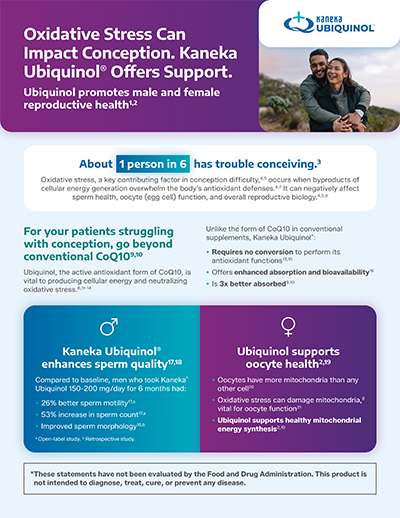
With a focus on preconception, this information sheet provides a brief overview of the science of ubiquinol, research findings, the Kaneka Ubiquinol® advantage, and identifying supplements with the Kaneka Quality Seal.
DownloadReproductive health is reliant on healthy mitochondrial function.
See more uses for Kaneka Ubiquinol®
REFERENCES: 1. Thakur AS, Littarru GP, Funahashi I, Painkara US, Dange NS, Chauhan P. Effect of ubiquinol therapy on sperm parameters and serum testosterone levels in oligoasthenozoospermic infertile men. J Clin Diagn Res. 2015;9(9):BC01-BC3. 2. Cakiroglu B, Eyyupoglu SE, Gozukucuk R, Uyanik BS. Ubiquinol effect on sperm parameters in subfertile men who have astheno-teratozoospermia with normal sperm concentration. Nephrourol Mon. 2014;6(3):e16870. 3. Mihalas BP, Redgrove KA, McLaughlin EA, Nixon B. Molecular mechanisms responsible for increased vulnerability of the ageing oocyte to oxidative damage. Oxid Med Cell Longev. 2017;2017:4015874 4. Agarwal A, Parekh N, Panner Selvam MK, et al. Male oxidative stress infertility (MOSI): proposed terminology and clinical practice guidelines for management of idiopathic male infertility. World J Mens Health. 2019;37(3):296-312. 5. Alahmar AT. Role of oxidative stress in male infertility: an updated review. J Hum Reprod Sci. 2019;12(1):4-18. 6. van der Reest J, Cecchino GN, Haigis MC, Kordowitzki P. Mitochondria: their relevance during oocyte ageing. Ageing Res Rev. 2021;70:101378. 7. Pallotti F, Bergamini C, Lamperti C, Fato R. The roles of coenzyme Q in disease: direct and indirect involvement in cellular functions. Int J Mol Sci. 2021;23(1):128. 8. Bentinger M, Brismar K, Dallner G. The antioxidant role of coenzyme Q. Mitochondrion. 2007;7(suppl):S41-S50. 9. Littarru GP, Tiano L. Bioenergetic and antioxidant properties of coenzyme Q10: recent developments. Mol Biotechnol. 2007;37(1):31-37. 10. Ernster L, Forsmark-Andrée P. Ubiquinol: an endogenous antioxidant in aerobic organisms. Clin Investig. 1993;71(suppl 8):S60-S65. 11. Martini FH, Nath JL, Bartholomew EF. Metabolism, nutrition, and energetics. In: Fundamentals of Anatomy and Physiology, 12th ed. Pearson Education; 2024:943-950. 12. Centers for Disease Control (CDC). Infertility: frequently asked questions. May 15, 2024. Accessed June 2, 2026. https://www.cdc.gov/reproductive-health/infertility-faq/ 13. Nugent CN, Chandra A. Infertility and impaired fecundity in women and men in the United States, 2015-2019. Natl Health Stat Report. 2024;(202):1-19. 14. National Institute of Child Health and Human Development (NICHD). How common is infertility? February 8, 2018. Accessed June 4, 2026. https://www.nichd.nih.gov/health/topics/infertility/conditioninfo/common 15. Bentov Y, Casper RF. The aging oocyte—can mitochondrial function be improved? Fertil Steril. 2013;99(1):18-22. 16. Zhu Z, Xu W, Liu L. Ovarian aging: mechanisms and intervention strategies. Med Rev. 2022;2(6):590-610. 17. Van Blerkom J. Mitochondrial function in the human oocyte and embryo and their role in developmental competence. Mitochondrion. 2011;11(5):797-813. 18. Adhikari D, Lee I, Yuen WS, Carroll J. Oocyte mitochondria—key regulators of oocyte function and potential therapeutic targets for improving fertility. Biol Reprod. 2022;106(2):366-377.