

Menopause
Kaneka Ubiquinol® Supports General Health and Well-Being During and After Menopause1,2
Awareness of the effects of menopause has grown substantially in recent years. The physical, social, and psychological effects experienced in the years surrounding menopause may affect quality of life. The decline of estrogen production is a key factor driving these changes.
Declining Estrogen Levels May Hamper Antioxidant Defenses and Promote Oxidative Stress3
Estrogen acts as a powerful antioxidant known to protect against lipid peroxidation, shielding membranes and low-density lipoprotein (LDL) cholesterol from oxidative damage.3,4
Menopause is linked with an increase in oxidative stress,3,5 which has an impact on cellular and mitochondrial DNA, energy production, lipids, and proteins6,7
After menopause:
- Antioxidant capacity is decreased3,4
- Oxidative stress markers increase3,5
Kaneka Ubiquinol® Supplementation Improved Menopausal Symptoms1
A consumer use study carried out in France showed improvements in self-reported menopausal symptoms in postmenopausal women taking Kaneka Ubiquinol® 200 mg/day for 60 days.1
81%
reported reduced irritability
81%
had fewer mood swings
82%
felt less stressed
81%
felt less sensitive
Kaneka Ubiquinol® Is the Active Antioxidant Form of CoQ108,9

Requires no conversion to perform its antioxidant functions10,11

Offers enhanced absorption and bioavailability over conventional coenzyme Q10 (CoQ10) supplements12

3x better absorbed than a conventional CoQ10 supplement13,14
Research demonstrates that 200 mg of Kaneka Ubiquinol® increases blood ubiquinol levels by approximately 8x compared to baseline in healthy adults when taken daily for at least 30 days.13
Download a Convenient, Science-Based Guide
Download a Convenient, Science-Based Guide
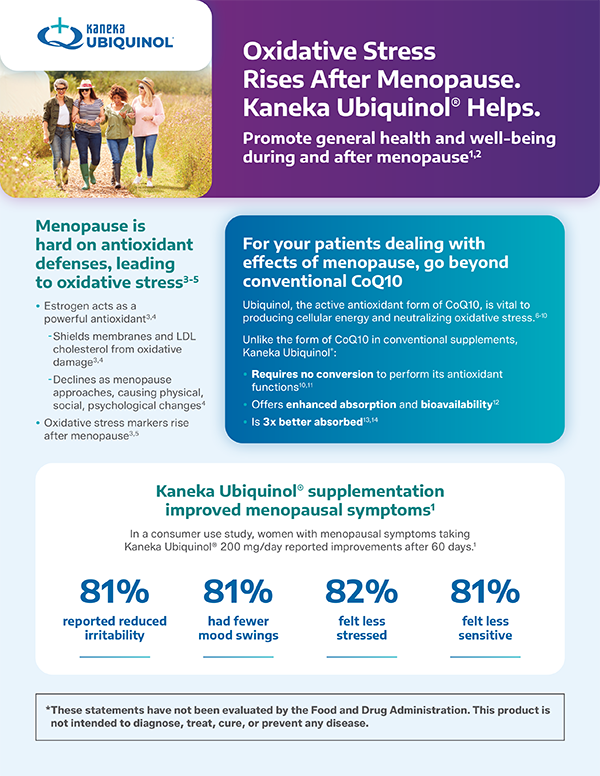
With a focus on menopause, this information sheet provides a brief overview of the science of ubiquinol, research findings, the Kaneka Ubiquinol® advantage, and identifying supplements with the Kaneka Quality Seal.
DownloadMenopause is closely tied to other key wellness factors, including cardiovascular health, mitochondrial health, and healthy aging.
See more uses for Kaneka Ubiquinol®
REFERENCES: 1. Kaneka Internal Report. Real-life UBIQUINOL study on 200 postmenopausal women. Expansion Consulteam. 2024. 2. Palacios S, Ramírez M, Lilue M, Barahona S, Rodríguez D. Estudio clínico para conocer la eficacia de la coenzima Q10 sobre la calidad de vida en mujeres postmenopáusicas. Toko-Gin Pract. 2019.78(1):3-7. 3. Vincent J, Inassi J. Comparison of oxidative stress between premenopausal and postmenopausal women. Nat J Physiol Pharm Pharacol. 2020;10(5):359-362. 4. Doshi SB, Agarwal A. The role of oxidative stress in menopause. J Midlife Health. 2013;4(3):140-146. 5. Heravi AS, Michos ED, Zhao D, et al. Oxidative stress and menopausal status: the Coronary Artery Risk Development in Young Adults cohort study. J Womens Health (Larchmt). 2022;31(7):1057-1065. 6. Bentinger M, Brismar K, Dallner G. The antioxidant role of coenzyme Q. Mitochondrion. 2007;7(suppl):S41-S50. 7. Sies H. Strategies of antioxidant defense. Eur J Biochem. 1993;215(2):213-219. 8. Littarru GP, Tiano L. Bioenergetic and antioxidant properties of coenzyme Q10: recent developments. Mol Biotechnol. 2007;37(1):31-37. 9. Ernster L, Forsmark-Andrée P. Ubiquinol: an endogenous antioxidant in aerobic organisms. Clin Investig. 1993;71(8 Suppl):S60-S65. 10. Kubo H, Yamamoto Y, Fujisawa A. Orally ingested ubiquinol-10 or ubiquinone-10 reaches the intestinal tract and is absorbed by the small intestine of mice mostly in its original form. J Clin Biochem Nutr. 2023;72(2):101-106. 11. Sabbatinelli J, Orlando P, Galeazzi R, et al. Ubiquinol ameliorates endothelial dysfunction in subjects with mild-to-moderate dyslipidemia: a randomized clinical trial. Nutrients. 2020;12(4):1098. 12. Langsjoen PH, Langsjoen AM. Comparison study of plasma coenzyme Q10 levels in healthy subjects supplemented with ubiquinol versus ubiquinone. Clin Pharmacol Drug Dev. 2014;3(1):13-17. 13. Hosoe K, Kitano M, Kishida H, et al. Study on safety and bioavailability of ubiquinol (Kaneka QH) after single and 4-week multiple oral administration to healthy volunteers. Regul Toxicol Pharmacol. 2007;47(1):19-28. 14. Ikematsu H, Nakamura K, Harashima S, Fujii K, Fukutomi N. Safety assessment of coenzyme Q10 (Kaneka Q10) in healthy subjects: a double-blind, randomized, placebo-controlled trial. Regul Toxicol Pharmacol. 2006;44(3):212-218.